Farming With Feathers: Utilizing Free Pest Control Through Sustainable Growing Techniques
Sarah E. Grimes
Beneficial birds and insects can provide powerful benefits for farmers. A single bluebird can consume over 2,000 insects per day, while many pollinators simultaneously support crop production. Yet across America’s farmlands, these natural allies are often overlooked in favor of intensive chemical solutions. As pesticide costs rise and resistance builds among insect pest populations, some specialty crop farmers are adopting more sustainable growing practices. By incorporating cover crops, installing nest boxes, creating pollinator habitat, and reducing chemical inputs, farmers can harness the natural work force of nature.
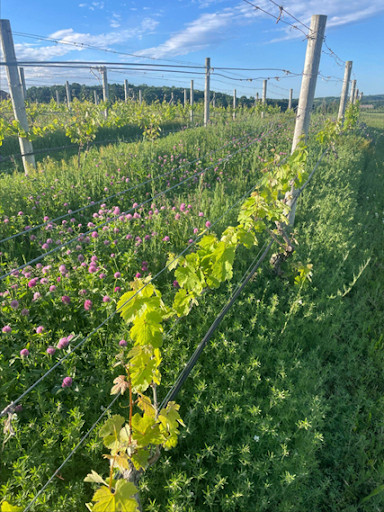
Flowering cover crop in a Traverse City, MI, vineyard. Photo taken by Sarah E. Grimes.
A number of sustainable techniques exist for specialty cropping systems such as orchards and vineyards. Such techniques may include cover crops, which involve planting non-crop, often flowering plants between rows of crops. The practice of cover cropping is often used in vineyards, and provides a multitude of benefits including reduced erosion, increased water retention, improvements in soil health, and pollinator habitat. Additionally, cover crops increase the vegetative diversity within specialty agriculture systems, which provides better habitat and food sources for birds.
The benefits of cover crops have been observed by Perry Kirkham, who owns the generational Wea Creek Apple Orchard in West Lafayette, Indiana. Kirkham’s family purchased the ancestral land in 1855. In the early 2000s, Kirkham and his family converted the agricultural land used for cattle into an apple orchard. Today, the orchard has over 4,800 trees including peach, apple, and
cherry trees. When Kirkham started the orchard, they used primarily conventional techniques. That changed a few years ago, and Kirkham has already seen benefits.
“When we first started out it was truly conventional, and we weren’t really good at cover cropping […] Then lately over the last 3-4 years we’ve put out a lot of cover crops. […] We have honey bees, so we try to do as many pollinator mixes as we can. We are going to start doing more prairie plants too. Thus far we have tried to kill the seed bed with regular winter rye but two years ago we began putting out native flower cover crops within cover crop mixes.”
The benefits of cover crops are far reaching. Although vineyards are self-pollinating and thus do not require pollination by insects, cover crops still provide a benefit to growers. When asked about the benefits of cover cropping, Esmaeil Nasrollahiazar, Michigan State University’s Viticulture Extensionist, explained:
“Cover crops increase vegetation complexity and attract insects, providing food and cover for birds. This promotes higher bird species richness and abundance. Certain species benefit more than others, depending on their foraging habits. Cover crops help mimic natural habitats, supporting both conservation and vineyard ecosystem services.”
By utilizing cover crops, specialty crop farmers are able to rely on insects for pollination, provide habitat for birds, and reduce pesticide and herbicide use. In fact, Kirkham explained that since planting cover crops, he has had to spend much less time weeding, and is seeing a difference in crop output:
“I think we’re making a big difference; we are certainly making a difference for the insects, and there is no question it is making a difference on our overall crop ability as well.”
These benefits help farmers save time and money and reduce the need to use expensive pesticides and herbicides.
In addition to cover crops, farmers can also utilize birds as a free pest control service. Although birds can damage crops such as by consuming grapes, or pecking at apples and peaches which damage them, birds can also consume many pest insects.
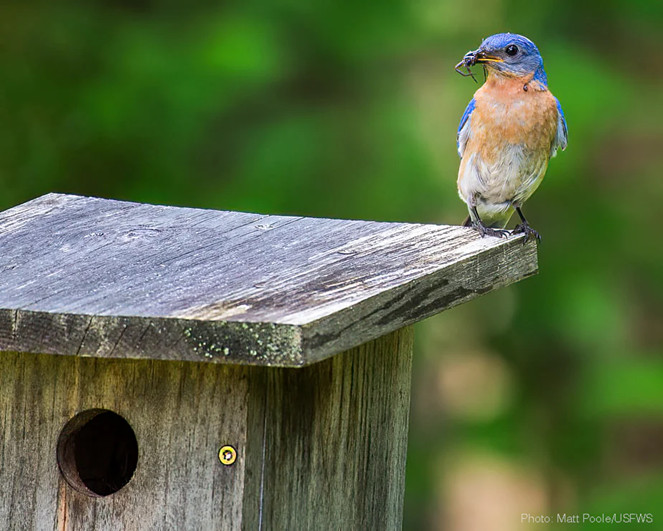
Eastern Bluebird on a nesting box holding an insect. Photo taken by Matt Poole, USFWS.
Using nest boxes can actually improve the services provided by birds. Dr. Julie Jedlicka is a professor in the Department of Biology at Missouri Western University. Her work in California investigated how nest box use in vineyards impacted the presence and services of Western Bluebirds, an insectivorous bird species. Her 2011 study found that the number of insect-consuming birds in vineyards with nest boxes increased by over 50%, while the number of fruit-eating birds, who act primarily as pests in vineyards, was unchanged. She also found that vineyards with nest boxes had almost 2.5 times more insects consumed by birds than vineyards with no nest boxes.
The increase in the amount of insects consumed by birds inhabiting nest boxes in vineyards is not insignificant. Such an increase has a clear impact on the amount of time and money that growers must invest to control insect pest populations.
Nest boxes can also provide homes for predatory birds, who may act to control pest birds and pest small mammals as well. Kestrel boxes are one such solution, although kestrel boxes may be inhabited by non-kestrel species such as European Starlings or House Wrens. Kirkham has attempted to use kestrel boxes in his orchard.
“We put out kestrel boxes about 5-6 years ago. We have had one kestrel but I don’t know how many others.”
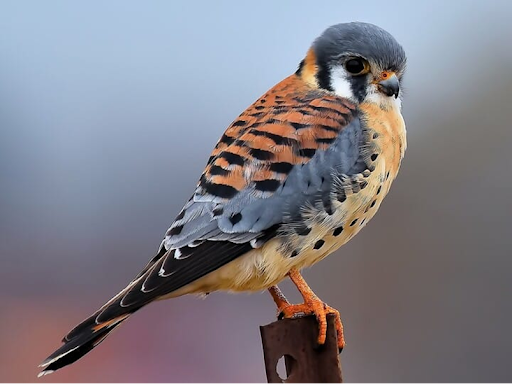
American Kestrel. Photo taken by Michael JD through the Macaulay Library.
While Kirkham has only had a few kestrels in his kestrel boxes, he also has seen eagles on his property, which have attracted local birdwatchers who come to his orchard to bird watch. While it remains unclear if this increases sales or income, Kirkham says attracting bird watchers is really a wonderful thing, and he enjoys it whether it’s an advantage or not.
Using sustainable practices like cover crops and nest boxes may be more than an ecological choice–it’s increasingly becoming a practical business decision and a way to connect with the local community for specialty crop farmers. While the adoption of these methods may seem daunting initially, farmers like Kirkham have found the transition both rewarding and effective.
Furthermore, such techniques are relatively accessible to farmers. “There’s really no significant barriers,” Kirkham notes. His experience mirrors what researchers like Dr. Jedlicka have documented: working with natural systems rather than against them can provide tangible benefits to agricultural productivity.
Perhaps most telling is how these practices transform not just the land but also the farmer’s relationship with it. As Kirkham explains, “It’s a lot of fun when you start getting into it and trying to understand how to do things, I really enjoy it. I think we’re making a big difference.”
As farmers like Kirkham demonstrate, integrating nature-based solutions into agricultural systems offers a promising path forward that simultaneously advances conservation goals, improves farm sustainability, and protects human health through reduced chemical dependence.