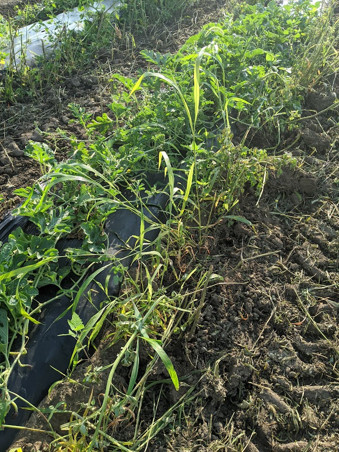
 About a third of the farmer phone calls and texts I receive as a weed science Extension specialist center around a lack of weed control in vegetable crops. The lines, “what went wrong?” and “what do I do now?” generally follow. As the summer starts to give way to fall, now is a good time to look back on the bulk of the 2026 growing season and ask yourself these same questions: “What worked this year and what didn’t?” Weed management is complicated and ever-changing. Below, I’ll discuss how rainfall and soil moisture can influence weed control tactics. I’ll cover other topics in the coming issues of Veg Crops Hotline
Rainfall (or overhead irrigation) is necessary to move soil-applied herbicides into the soil profile where weed seeds are actively germinating. This allows them to be taken up by emerging weed seed roots (radicals) and/or shoots (coleoptiles and hypocotyls). However, when rainfall (or irrigation) is lacking some weeds can germinate and grow through the herbicide-treated soil before it is “activated”. The longer a soil-applied herbicide remains on top of the soil, the more it can be broken down, meaning less active ingredient moves into the soil when rainfall or overhead irrigation eventually does occur. This is especially true for herbicides that can be degraded by sunlight (photodegradation).
Too much rainfall can move soil-applied herbicides deeper in the soil profile diluting their concentration in the upper portion of the soil where most weeds originate. For herbicides that are moderately or highly leachable this means fewer days of residual weed control, especially on low organic matter and sandier soils. Of course, if rainfall is heavy enough to result in soil erosion, the herbicide you applied is likely moving along with the eroded soil, resulting in portions of the field effectively losing their residual herbicide entirely.
Rainfall also plays a role in the effectiveness of postemergence herbicides. Rainfastness, the ability of a herbicide to resist being washed off the leaf surface, varies among herbicides. Herbicides applied to manage emerged weeds must make their way through the waxy leaf surface (cuticle) of the weeds we are targeting. Adjuvants, like crop oil and non-ionic surfactant, help with this process, but it still takes time. One to several hours of rain and overhead irrigation-free time are needed. A heavy rain shortly after applying a postemergence herbicide can greatly diminish the amount of herbicide taken into the targeted weeds, reducing its effectiveness. So, if you heard distant thunder as you and your spray boom were leaving the field, it’s likely that herbicide uptake was reduced and resulted in decreased weed control.
One more consideration for rainfall and postemergence herbicides- rainfall and soil moisture effect crop and weed vigor. When weeds are stressed due to waterlogged or water deprived soils, they are less effective at taking up and moving systemic herbicides into their growing points. Systemic herbicides work best on small, actively growing weeds. If weeds are not “actively growing” due to water stress, this may result in decreased control.
Finally, rainfall and its resulting effects on soil moisture also influence mechanical weed control tactics. Under wetter soil conditions, soil may clod and prevent adhering weeds from being uprooted. Some of those weeds that are uprooted may reroot if they are left on top of moist soil or if rainfall follows a cultivation event. Some in-row weeding implements, including tine and finger weeders, will not perform well in dry or crusted soil. Furthermore, rainfall can delay cultivation. When the interval between cultivation events increases, so too does weed size. Larger weeds are often far more difficult to control with cultivation and more likely to reroot.