As strawberry harvest winding down, growers are preparing for next year’s planting. A question among plasticulture strawberry growers is whether to establish a new strawberry patch using plug plants or bare-root plants.
Plug plants are actively growing transplants produced from runner tips and typically sold in 50-cell trays filled with soilless growing media. In contrast, bare-root plants are dormant plants dug from nursery fields and consist of a crown with an exposed root system. Both plug and bare-root plants can be successfully used to establish plasticulture strawberry plantings.
A major advantage of using plug plants in a plasticulture system is their ease of planting and their rapid, reliable establishment. In contrast, planting bare-root plants on plastic-covered beds can be labor-intensive, requiring experienced workers and take long time to plant large areas. Depending on weather conditions during planting, overhead irrigation maybe needed to ensure successful establishment of bare-root plants in the summer. Despite advantages of using plug plants, bare-root plants offer benefits of their own. First, bare-root plants are less expensive, often costing about half as much as plug plants. Considering that a standard plasticulture system may require up to 15,000 plants per acre, the cost savings can be substantial. Second, growers often have access to a wider selection of cultivars when purchasing bare-root plants compared with plugs. Third, the planting window for plug plants is relatively narrow in the Midwest, whereas bare-root plants generally provide greater flexibility in planting date.
Because both plug and bare-root plants have their own strengths and weaknesses, fruit growers may choose to use both planting materials as a form of insurance. This strategy can help address challenges such as limited plant availability, variable establishment success, and concerns about crown diseases. If growers decide to use one or both types of planting material, it is important to understand the factors that should be considered when planting each type.
Starting with plug plants
Plugs should be planted no later than mid-September in southern Indiana or early September in northern Indiana, with mid- to late- August being the preferred planting window. However, planting in August is not always possible because plant availability can be limited.
The timing of plug availability depends on how the plants are produced. Plug plants are grown from runner tips, which are harvested either from mother plants grown in nursery fields in cooler climates or from hanging mother plants maintained in greenhouses. Growers may purchase finished plug plants from regional plug producers that receive runner tips from northern nurseries, or they may purchase runner tips and produce their own plugs on-site. The timing of plug plants availability is largely determined by when runner tips are harvested and shipped from northern nursery fields, which make plug plants available only a short window from later summer to fall. Plugs produced from greenhouse-grown mother plants are often available over a longer period. However, growers may need to place orders with greenhouse plant suppliers well in advance to ensure plant availability.
Planting plugs is similar to transplanting vegetables. A water-wheel transplanter is well suited for this purpose. Under adequate soil moisture, plug plants establish quickly, even during hot summer conditions and regardless of whether they are planted on black or white plastic mulch.
Starting with bare-root plants
Bare-roots are typically available from spring through summer. They should be planted a few weeks earlier than plug plants. However, planting too early can promote excessive runner production, which is undesirable in plasticulture systems. We have not conducted research to determine the optimal planting date for bare-roots in plasticulture system in Indiana. Based on growers’ experience, planting from July to early August could provide satisfactory results. Because bare-root plants are available since in early spring, fruit growers wait until summer to place orders may find some cultivars are already sold out.
Establishing a strawberry planting with bare-root plants is labor-intensive. Bare-root plants must be planted at the proper depth. If planted too deeply, the crowns are fully buried and may rot; if planted too shallowly, crowns may not contact with soil and the roots may dry out. Some growers plant bare-root strawberries by hand using specialized strawberry planting tools. This approach requires experienced workers and are time-consuming. Other growers have experimented with trimming roots to 2–3 inches and using a water-wheel transplanter. In our preliminary observations, this method appears to be more successful with vigorous plants. Bare-root plant quality and cultivar characteristics may influence establishment success. Planting depth and other establishment practices may need to be adjusted, as optimal settings can vary depending on soil conditions and plant characteristics. In addition, newly planted bare-root plants should be monitored carefully, particularly after heavy rainfall, to ensure that crowns are not exposed when soil is washed out of the planting holes. We have observed that some bare-root plants established using the method described above developed branch crowns positioned above the soil surface (Figure 1). These exposed branch crowns may not survive freezing temperatures in the winter. Intensive labor requirement with bare-root plants also come from removing flowers. Because bare-root plants often contain pre-formed flower clusters in the crown, plants begin flowering shortly after planting. These flowers should be removed to encourage plant vegetative growth, the same practice used in spring-planting in a matted-row system.
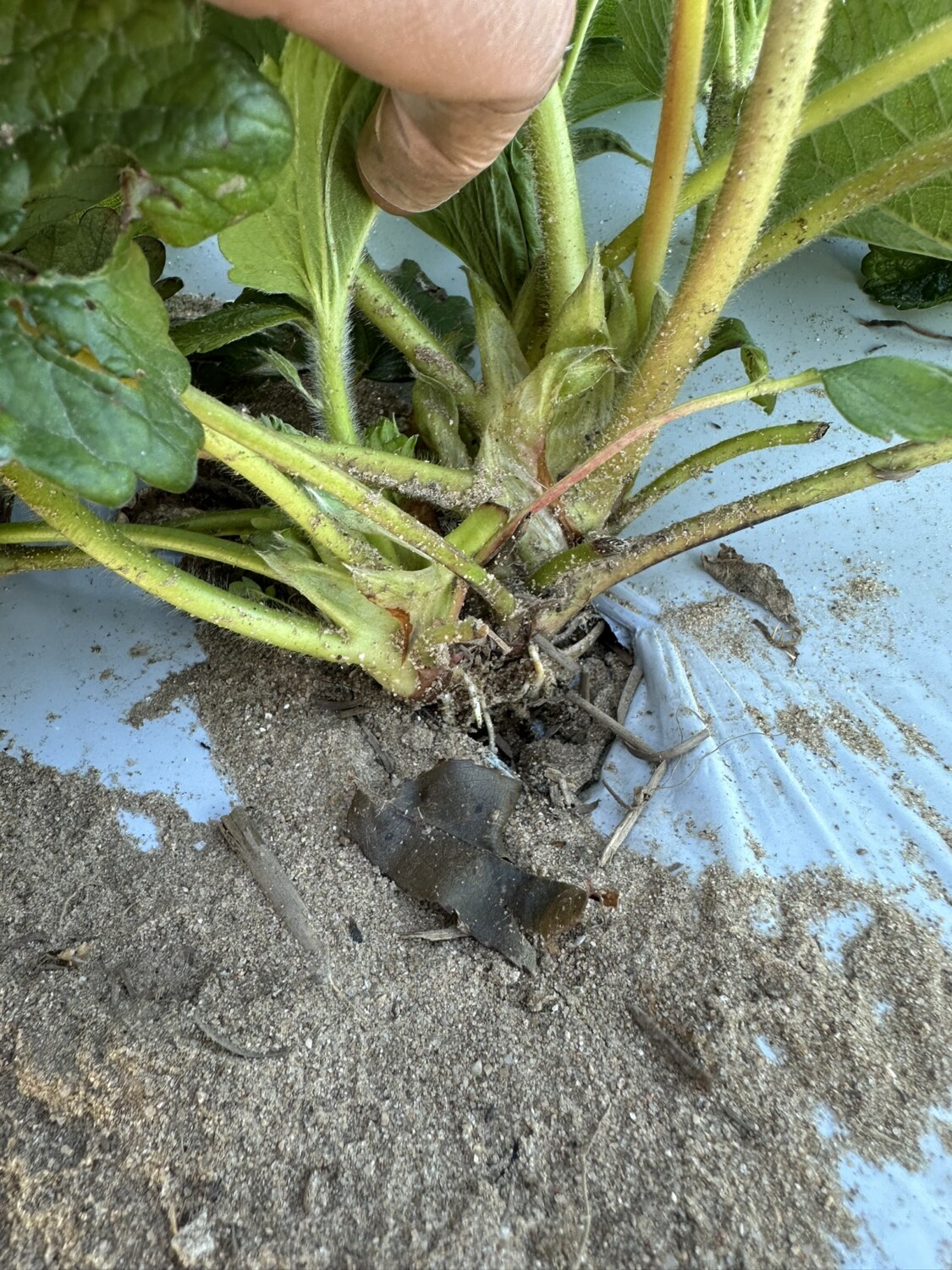
Figure 1. Newly developed branch crowns were above soil surface. Those exposed branch crowns may not survive in the winter. The photo was taken in November on a strawberry plant established from bare-root plants (Photo credit: Wenjing Guan)
Maintaining adequate soil moisture is critical for successful establishment of bare-root strawberry plants. Because bare-root plants can be stored temporarily in a refrigerator at 32–40°F, growers often schedule planting during cooler weather or when rainfall is forecast. Planting under cool and cloudy conditions can greatly improve establishment success. When hot and dry conditions cannot be avoided, frequent irrigation through drip tapes is essential, and sometimes supplemental overhead irrigation may be needed. Because summer heat poses a risk of establishment failure, white plastic mulch is preferred over black plastic mulch when establishing strawberry plantings with bare-root plants. The high labor demand associated with planting and managing bare-root strawberry plants during the summer can present a challenge for produce growers, as this period typically coincides with the peak of the production season.
A modified approach to using bare-root plants is to establish them in large-cell trays and then transplant them to the field after they have developed root systems, similar to the use of plug plants. Although this method requires additional labor and materials to establish the bare-root plants in trays, it can significantly improve establishment success in the field. An additional advantage is that flower can be removed while the plants are still in trays, where they are easier to access and manage, which eliminates the need for flower removal after transplanting, potentially lowering labor requirements during field establishment.