We have seen increasing interest in harvesting strawberry runner tips and producing plug plants on-farm for the next year’s planting. This practice is allowed for cultivars that don’t have a patent or patent has expired. Several excellent Extension publications describe this process, including Strawberry Plug Plant Production published by Utah State University, and Propagating Strawberry Plants Through Runners published by Cornell Cooperative Extension. While the technical process of harvesting runner tips and producing plugs is relatively straightforward, this approach may not be practical or economically viable for all growers. In addition to facility required, such as greenhouse space and a mixing irrigation system, several other factors should be considered before deciding whether on-farm runner tip harvest and plug production is a suitable option. In this article, we discuss some of the key consideration growers should take into account.
Producing plug plants from runner tips is a relatively fast process, typically taking about four weeks from sticking the runner tips to producing field-ready transplants. Therefore, careful planning is essential. Growers should first determine their target field planting date and then schedule runner tip harvest and rooting accordingly. It is equally important to ensure that planting beds are prepared and ready when the plug plants reach the appropriate stage for transplanting. Runner tips are ideally rooted immediately after harvest. While this may be feasible on a small scale, temporary storage maybe necessary when a large amount of plugs are being produced. In these situations, growers should consider how storage may affect labor scheduling, plant quality, and rooting success.
The following questions are: how long can runner tips be stored, and under what conditions? In the publication Recent Advances in Strawberry Plug Transplant Technology (2002), the authors recommend cooling runner tips to 32°F immediately after harvest and maintaining temperatures below 37°F. They note that well-handled runner tips can be safely stored for up to one week, although every effort should be made to root them as soon as possible after harvest. More recent studies suggest that storage periods can be extended to as long as one month under dark, above 95% relative humidity and cold storage conditions. However, prolonged cold storage generally reduces the percentage of runner tips that successfully develop roots compared with freshly harvested tips.
Both harvesting runner tips and rooting them into plugs are labor-intensive processes. Growers should carefully plan these activities to fit within often-demanding summer production schedules. In addition to labor requirements, harvesting a large number of runner tips within a short period may not be feasible, depending on the availability of healthy mother plants and the cultivar’s capacity to produce runners. An ideal runner tip for plug production should have visible root nodules but not dried roots, at least two trifoliate leaves, and a crown with diameter about 3-4 inches (Figure 1).
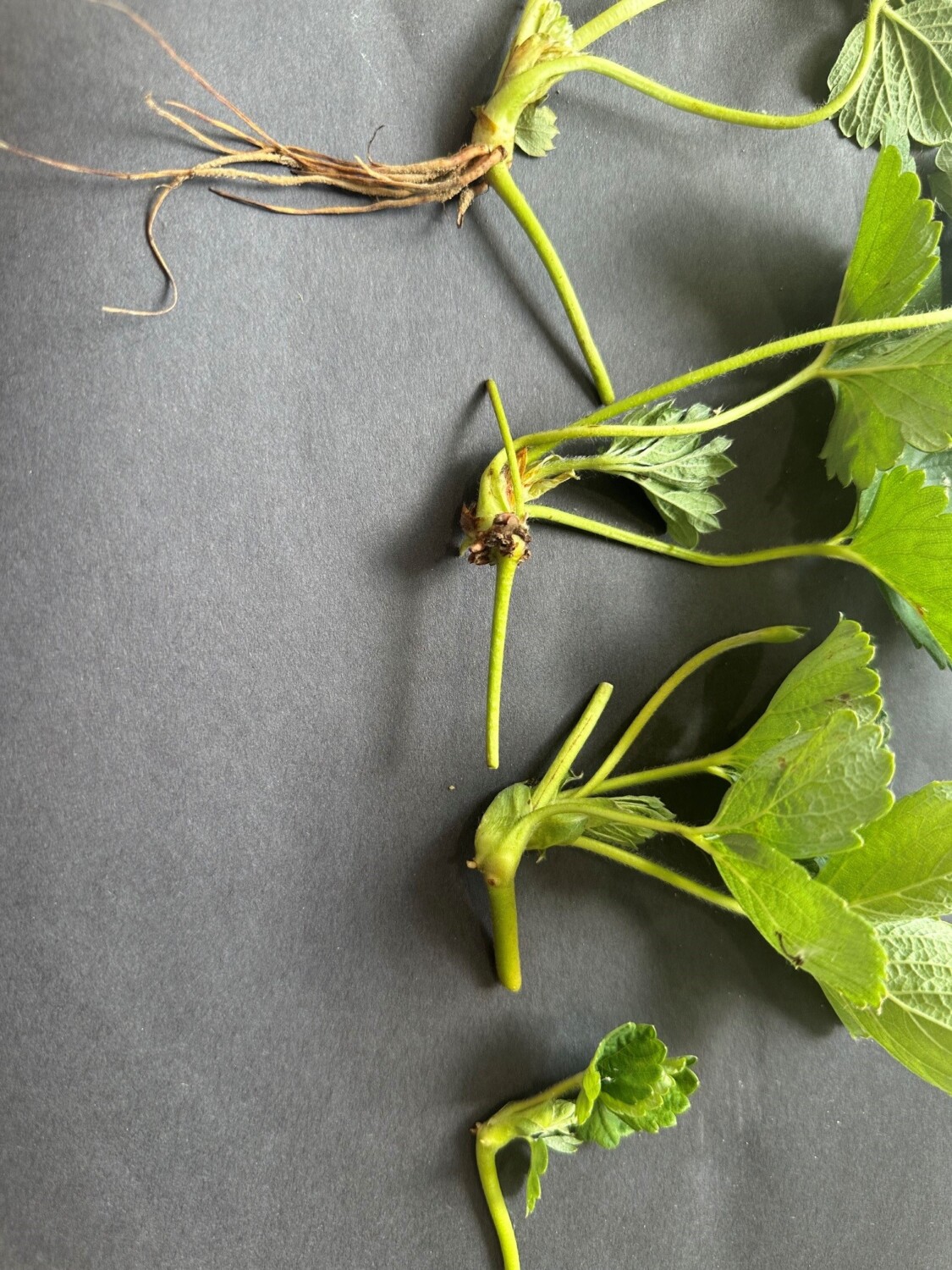
Figure 1. Runner tips at different developmental stages. The second runner tip from the right is at the ideal stage for plug plant production.
Smaller runner tips have a lower likelihood of successful rooting and may produce less vigorous plug plants. Sorting runner tips by size before rooting is an important step to improve uniformity among the resulting plugs. If a sufficient number of acceptable runner tips cannot be harvested at one time, the tips collected earlier may need to be stored temporarily until enough runner tips are available to complete a rooting batch.
Some growers may prefer to postpone runner tip harvest until a sufficient number of runners are available. Although this strategy may minimize storage requirements, it can also increase disease risk. Following fruit harvest, fungicide applications are often reduced or discontinued, allowing foliar diseases to develop in the field. As runner tips continue develop from mother plants, their exposure to pathogens may increase. The high-humidity conditions required for rooting are highly favorable for disease development. Commercial plug producers commonly rely on fungicide programs during this stage to prevent disease outbreaks. If fungicides are not available or their use is limited, growers who plan to produce their own plugs should make every effort to minimize the introduction of pathogens into the rooting environment to reduce the risks. Another consideration is that, depending on field conditions and whether weed barriers are used between rows, some runner tips may have already rooted in the soil. These rooted daughter plants should not be used for plug production because they carry soil particles and can be more difficult to handle and establish uniformly in plug trays.
In summary, while harvesting runner tips and producing plug plants on-site is possible, growers should carefully weigh the associated labor, logistics, and disease-management challenges in the context of their own operations.