When growers are asked about the top challenges in plasticulture strawberry production, frost/freeze damage are almost always at the top of the list. Anyone living in Indiana understands how unpredictable spring weather can be. This year, in southern Indiana, we experienced warm periods with average daily temperatures exceeding 60 °F in mid-February, followed by sharp drops to below 20 °F over a few nights. A similar pattern occurred again in March—after average temperatures approached 70 °F in early March, they plunged to below 20 °F in a single night by mid-month. These roller-coaster temperature fluctuations are not unusual. They can occur at any point from late February to April, and their timing and intensity vary from year to year.
The extent of frost/freeze damage in strawberries depends largely on the developmental stage. Open blooms are the most sensitive, with injury occurring around 30-32 °F. Developing fruit may be injured at about 28 °F. Popcorn and tight bud stages are more tolerant, with critical temperatures ranging from approximately 22 to 27 °F. Spring temperatures are generally not a concern before flower clusters have emerged from the crown.
In general, plants bloomed earlier are associated with a higher risk of frost/freeze injury. However, there are situations plants that bloomed earlier and had already set fruit experienced minimal damage, while plants that were actively blooming at the time of a frost event suffered the greatest injury. Since we can not control timing and intensity of these events, a practical approach is to prevent plants from blooming too early, and spread blooming period across plants. Doing so can reduce overall risk and allow us to concentrate frost protection measures, such as row covers, on plants that are at the most susceptible develop stages. Additionally, spreading out the blooming period also extends the harvest window, which can provide marketing advantages. In this article, we will discuss a few practical approaches to help distribute bloom timing.
Plastic mulch color
The choice between black and white plastic mulch can influence bloom timing. For the same cultivar, plants grown on black plastic mulch typically bloom about one week earlier than those grown on white mulch, due to the greater soil-warming effect of black plastic in the spring. However, this difference tends to diminish when plasticulture strawberries are carried into a second harvest year. This is likely because mulch color also affects plant growth and development in other ways, which can complicate its overall impact on bloom timing after plants have developed multiple branch crowns.
Winter management
Both straws mulch and row covers are commonly used to protect plasticulture strawberries during the coldest part of winter in our region, and growers often ask when these coverings should be removed. While there is no single definitive answer, some general considerations can help guide decision-making.
In the coldest period in the winter, we often experience minimum temperatures < 10 °F or even < 0 °F. These extreme cold events could occur in December, January or February. Once the coldest period has passed, typically in February, row covers can be removed to slow spring growth and help prevent plants from blooming too early. For example, this year we experienced temperatures below 0 °F in late January. Row covers at our trial was removed in early February, even though nights below 20 °F were still expected. At that point, plants that have already acclimated to winter conditions are less likely to suffer crown damage from those temperatures.
Straw mulch functions differently from row covers. Because straw blocks light, it inhibits plant growth even during warm periods in early spring. After straw is removed, plants typically require more time to resume active growth compared to those previously covered with row covers. As a result, using row covers and straw mulch to cover different patches can be a strategy to spread out the spring blooming period. Delaying straw removal until late March, for example, can result in much later blooms. However, this approach may come with tradeoffs, including reduced yields due to the loss of early-season growing degree days.
Select a combination of early, middle and late season cultivars
Genetics can be used to separate the blooming period, and planting a combination of early-, mid-, and late-season cultivars is one of the most common approaches to spreading out harvest. Plant suppliers often provide information on cultivar characteristics; however, growers should recognize that these descriptions are relative. First, there are limited side-by-side comparisons that include a wide range of varieties from different sources. Second, performance data generated under a specific production system may not translate directly to other environments or management practices. Growers are encouraged to consult cultivar evaluations conducted in their region and under similar production systems, trial multiple cultivars on their own farms, and keep good records to identify the combinations that best fit their conditions.
References:
Frost Damage. NC State Extension
Arana, J. Meyers, S.L. Guan, W. 2025. Evaluation of June-bearing strawberry cultivars under a two-year plasticulture system using black and white mulch colors in the lower Midwest. HortTechnology. DOI: 10.21273/HORTTECH05781-25
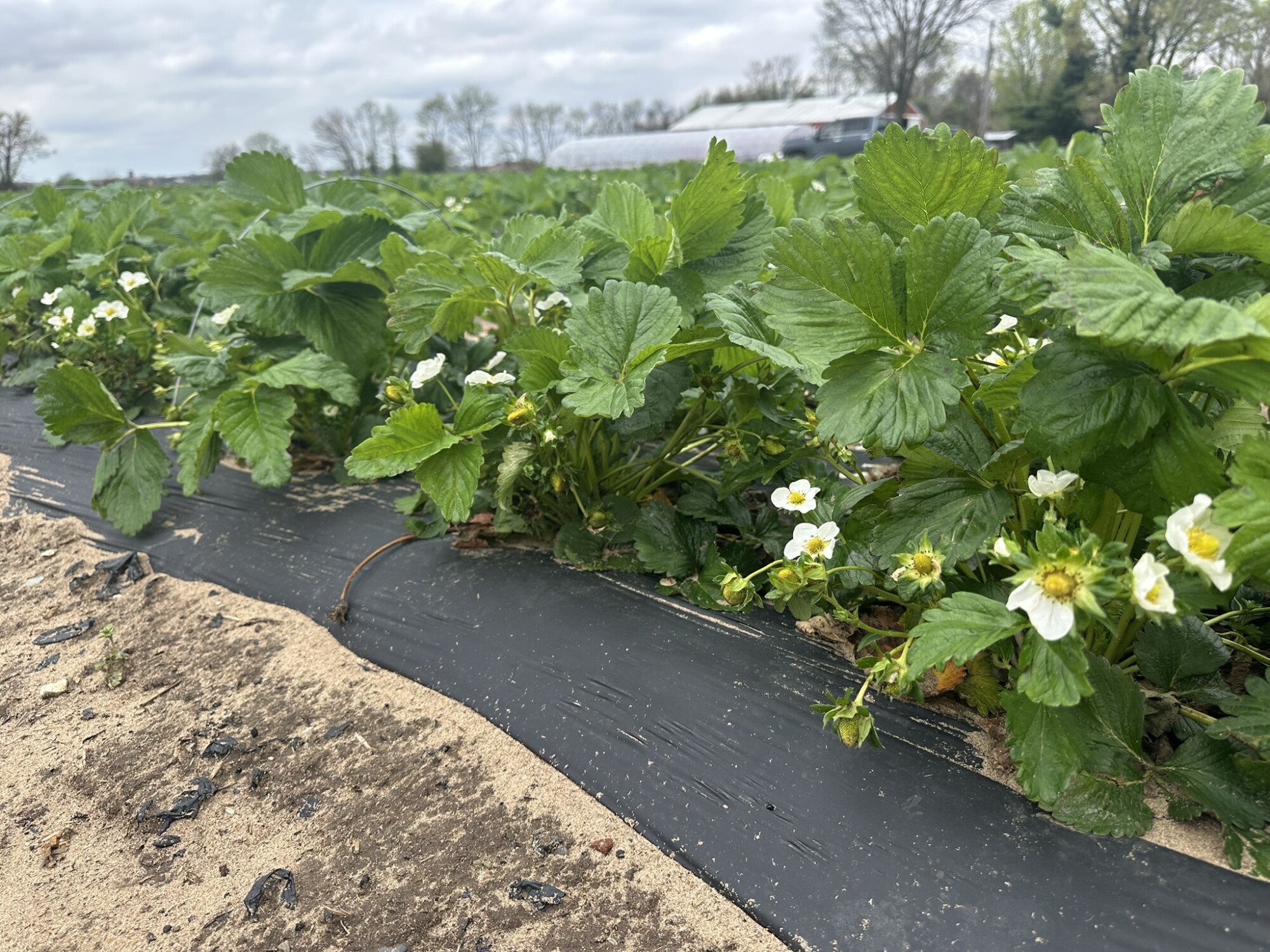
Blooming and fruit set of strawberry plants grown on a plasticulture system