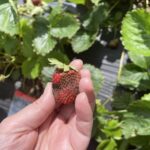
Wet weather throughout the Midwest has resulted in explosive anthracnose outbreaks in Indiana, Illinois, Kentucky and Ohio. Although it is too late to save the fruit crop, actions can be taken to protect daughter-plant establishment and to develop a plan for future disease management. Anthracnose is one of the most devastating diseases impacting strawberry production…Read more about Managing Anthracnose in Strawberry[Read More]
Disease Management

Dacthal® flowable herbicide is currently produced by AMVAC Chemical Corporation and registered for use in numerous vegetable crops (Midwest Vegetable Production Guide (mwveguide.org)) and strawberry. It provides pre-emergence control of small-seed broadleaf weeds and grasses. Dacthal herbicide contains the active ingredient DCPA. On April 28, 2022 the United States Environmental Protection Agency issued a notice…Read more about Future of Dacthal® Herbicide Uncertain[Read More]
We’re getting close to the time when growers need to make chemical thinning decisions – for many the most perplexing and risky decision they will make all year. This is usually a tricky call to make. Remember that only about 5-10% fruit set is usually enough for a full crop. In other words, 90 out…Read more about Chemical thinning[Read More]
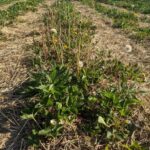
Historically Stinger® herbicide application in Indiana strawberries was limited to post-harvest. A new 24(c) Special Local Needs Label now includes a spring application (Figure 1). Why does it matter? A spring application of Stinger® will help to manage certain difficult-to-control broadleaf weeds in the spring. This will reduce reliance on hand-weeding, reduce competition between…Read more about New 24(c) Special Local Need Label Allows for Spring Stinger® Herbicide Application in Strawberry[Read More]
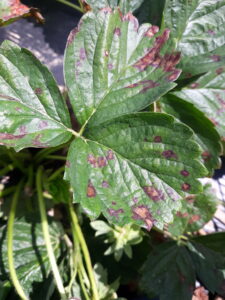
A new strawberry disease has been found in Indiana and researchers are looking for samples to determine the extent of the problem. The disease, caused by a species of the fungus Neopestalotiopsis, has been reported in several southeastern states and other countries where it causes leafspots, fruit spots and a plant decline. In Indiana, the…Read more about New Strawberry Disease[Read More]
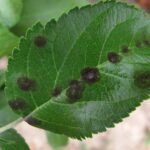
The only thing predictable about Indiana weather is that it will certainly be unpredictable! The past few weeks of cool weather and intermittent freezes has slowed some things down. Unfortunately, scab isn’t one of those things. Failure to control early season scab infections increases the risk of economic losses. When managing scab, it is important…Read more about Apple Scab and Ascospore Maturity[Read More]
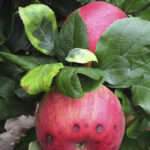
In Indiana, our ‘normal’ or average weather is one of extremes, punctuated with an occasional glorious summer day of sun and 76 degrees F. This year has been one of flooding and droughts, freezes and scorching heat. Again. With these weather extremes come physiological disorders and summer fruit rots, for those lucky enough to even…Read more about Pits, Spots and Rots[Read More]
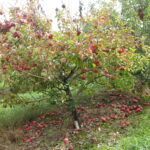
Throughout Indiana orchards, Phytophthora root and crown rot continues to be a major cause of tree death (Fig. 1), and losses in small fruit, as well (Fig. 2). The disease is caused by the several members of the genus Phytophthora, and includes (but is by no means limited to) the following species): P. cactorum, P….Read more about Recent Rains Driving Phuture Phytophthora Problems[Read More]
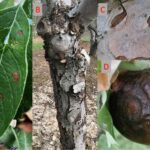
Frogeye leaf spot, caused by the fungal pathogen, Botryosphaeria obtusa, has been quite prevalent this year, probably due to the combination of potential (and realized) crop loss and our cool, wet spring. This is the same fungus that causes cankers on the tree, along with black rot of apple fruit (Fig. 1). Frogeye leaf spot…Read more about Frogeye leaf spot[Read More]
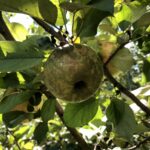
For those of you still fortunately enough to have apples, disease management continues to a greater degree than those of us without a crop. Around now (the beginning of cover sprays), the most serious apple pathogens are generally less active, terminal buds have set, leaves have hardened off (and are now less susceptible) and weather…Read more about Fungicide Use Midseason and On[Read More]