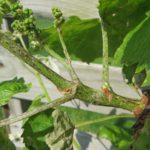
The weather this spring has been ideal for development of Phomopsis cane and leaf spot. The past few weeks have been cool with frequent showers, and shoot growth has been slow. These conditions favor sporulation and infection by Phomopsis. This pathogen is one of the major causes of fruit rot in the Midwest. Early season…Read more about Phomopsis cane and leaf spot in grapes[Read More]
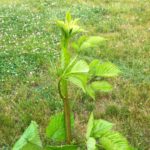
Tipping of primocanes (new vegetative canes from the ground) is an important management practice for summer bearing blackberries and black raspberries. Tipping the new primocanes causes lateral branching and most of the fruit production next year will be from buds on those lateral branches rather than buds off the main cane. Tipping also helps increase…Read more about Summer tipping brambles[Read More]

Immediate post-bloom through about 3 weeks post bloom is the most effective time for leaf removal on tight clustered varieties such as Vignoles, Seyval, and Pinot gris. That time will be coming up soon in southern Indiana. Removal of 3 to 5 leaves in the cluster zone can greatly reduce risk of Botrytis bunch rot….Read more about Leaf removal in grapes[Read More]
As reported in the last edition of Facts for Fancy Fruit, we achieved biofix in Lafayette on May 9. With a lot of cool weather since then, we have only achieved 170.5 degree days as of May 24. This is a year when monitoring degree days has the potential to greatly improve your levels of…Read more about Codling Moth[Read More]
I received one of the most unusual samples to identify last week that I’ve seen during my time at Purdue. The sample contained almond nuts that were severely damaged by plum curculio. First, I didn’t know we could grow almonds in Indiana and, second, I didn’t know that plum curculio was a pest of almonds….Read more about Plum Curculio in Almonds[Read More]
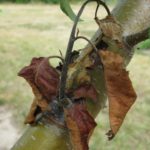
Fire blight seems to have established itself in many orchards throughout the state, meaning it can still be a huge threat in the event of trauma, like hail, due to secondary spread. Secondary spread develops when stormy weather, especially hailstorms, occurs after the primary (blossom) infections. The amount of fire blight that develops after severe…Read more about Fire Blight[Read More]
Blueberry Growers of Indiana Spring Meeting and potluck June 9, 2016, 4:00 pm Sider’s Blueberry Farm. 6254 W. 200 North, Rochester, IN. More information will follow. Indiana Winery and Vineyard Association Summer meeting July 19-20, 2016 Brown County Inn. Nashville, IN. More information will follow. Indiana Hort Society Summer Field Day June 22, 2016 David…Read more about Upcoming Events[Read More]
Finally we have some warm, sunny weather, and that means fruit are growing quickly. Generally, fruit are 10–20 mm depending on where in the state you’re located. Many of our common post bloom thinners such as NAA, Sevin and Maxcell work very well when fruit are around 12mm and temperatures are in the 70s. Once…Read more about Apple Chemical thinning[Read More]
We’ve all heard of apple June drop, but what is it, what are the causes and why should we care? June drop is more correctly called physiological fruit drop and is caused by a shortfall of carbohydrates in the tree. This shortfall is because the trees have limited leaf area for photosynthesis (supply of carbohydrates)…Read more about Apple June drop[Read More]
Purdue University prohibits discrimination against any member of the University community on the basis of race, religion, color, sex, age, national origin or ancestry, genetic information, marital status, parental status, sexual orientation, gender identity and expression, disability, or status as a veteran. This material may be available in alternative formats. 1-888-EXT-INFO Disclaimer: Reference to products in this publication is not intended to be an endorsement to the exclusion of others which may have similar uses. Any person using products listed in this publication assumes full responsibility for their use in accordance with current directions of the manufacturer.