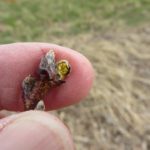
Following a very early warm-up, temperatures cooled off the middle of March slowing crop development and bringing us back closer to normal. In southern areas, peaches are in full bloom, but only just showing a little pink in more northern areas. Apples are still in tight cluster and probably at least 10 days from full…Read more about Crop Conditions[Read More]
The proper time to remove straw from matted row strawberries is when the bare-soil temperature at 4 inches averages about 40-43˚F. This usually coincides with mid to late March in central Indiana. This year is earlier than average with soil temperatures well into the 50s in early March, but they dropped back below 40 during…Read more about Straw removal on strawberries:[Read More]
Spring freeze damage can be a significant economic problem for Midwest grape growers. Widespread damage occurred in 2007 and 2012 when warm temperatures in March were followed by freezing temperatures in April. Obviously this year we have had a very warm February, but more normal March. So far it looks like bud swell is on…Read more about Avoiding spring freeze injury in grapes[Read More]
March is a good time to finish pruning summer-bearing brambles. Last years fruited canes should be removed now if they were not removed last summer or fall. Remove weak or spindly floricanes and thin to 4-6 canes per foot of row. Laterals on blackberries and black raspberries should be shortened to about pencil diameter on…Read more about Pruning brambles[Read More]
Anthracnose, caused by Elsinoe veneta, is a common fungal disease of brambles. It is mainly a problem on black raspberries and some blackberries. It is much less common on red raspberries. Most modern thornless blackberries (Apache, Triple Crown, Osage, Ouachita, etc) are resistant to anthracnose. However, if you grow a susceptible variety, is is important…Read more about Raspberry Anthracnose[Read More]
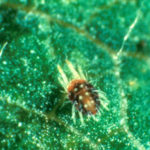
Managing Mites in a BMSB World For several decades, apple growers in Indiana and elsewhere in the Midwest have used a highly effective system to manage European red mites that is based on conservation of the predatory mite, Amblyseius fallacis, along with timely applications of either preventive or rescue miticides. The rationale behind this approach…Read more about Managing Mites in a BMSB World[Read More]
Wine Grape Team Spring Workshop April 13, 2017 Belgian Horse Winery Middletown, IN For further information contact Jill Blume at blume@purdue.edu Indiana Horticultural Society Field Day June 28, 2017 Tuttle Orchard Greenfield, IN More details to come but mark the date on your calendar and plan to attend Indiana Horticultural Congress February 13-15, 2018 Indianapolis Marriott East Indianapolis, IN For further…Read more about Upcoming Events[Read More]

The temperature data shown in Figure 1 will come as no surprise to anyone. This spring we had a very early warm period, much earlier than anytime this decade and even earlier than 2012. This started in mid February and continued for a couple of weeks. Thankfully since the start of March, we returned to…Read more about Spring temperatures[Read More]
The results of a historical primate behavior analysis suggest that species with fruit-filled diets evolved larger brains. A popular theory among evolutionary biologists is that we have our sociability to thank for our big brains. This “social brain hypothesis” suggests that the mental effort involved in interacting with others eventually increased our cognitive capacity. However,…Read more about New study: Diet contributes to brain size[Read More]
Purdue University prohibits discrimination against any member of the University community on the basis of race, religion, color, sex, age, national origin or ancestry, genetic information, marital status, parental status, sexual orientation, gender identity and expression, disability, or status as a veteran. This material may be available in alternative formats. 1-888-EXT-INFO Disclaimer: Reference to products in this publication is not intended to be an endorsement to the exclusion of others which may have similar uses. Any person using products listed in this publication assumes full responsibility for their use in accordance with current directions of the manufacturer.