Grapes have grown quickly this past week and most varieties are now past bud burst. The earliest have 4 to 6 inch shoots at this time. Blackberries and raspberries are also growing rapidly, with new primocanes emerging from the ground and laterals on floricanes out to 4 inches or longer. Flower buds are visible on…Read more about Crop Conditions[Read More]

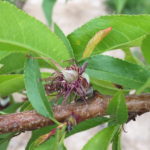
It isn’t every year we get our peach trees to produce, but when we do, we want to make sure we get them to harvest! One of the most important sprays to protect peaches from leaf curl (Fig. 1) should have gone in late fall (best time) or in late winter (by end of February),…Read more about Protecting Peaches[Read More]

Upticks in powdery mildew last year, plus a mild winter (which allows the fungus to overwinter in buds) set the stage for powdery mildew (Fig.3). Early season rains kept things at bay, but the recent change to drier weather while leaves continue to grow sets the stage for this disease. Powdery mildew is active during…Read more about Powdery Mildew on Apple[Read More]
Codling moths are flying in some parts of the state. Place your pheromone traps in the orchard during bloom. I have not yet caught any in my traps but expect to soon. We define biofix as the first sustained flight of moths. Therefore, we don’t determine biofix when that first moth shows up in the…Read more about Codling Moth[Read More]
Eastern flower thrips are an occasional pest of strawberries. They are attracted to and feed on flowers, with the result being leathery fruit or fruit that fail to ripen. This problem occurs every year at low levels but has not been serious in recent years, with the last serious problem in 1994. Eastern flower thrips…Read more about Eastern Flower Thrips in Strawberries[Read More]
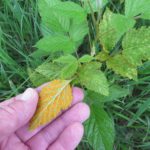
Orange rust is one of the most common diseases of blackberries and black raspberries in the Midwest. It is a systemic disease that is confined to Rubus spp. (autoecious). There are two forms, a long-cycle form that occurs on black raspberry, and a short-cycle form that occurs on blackberries. There are two causal organisms: Arthuriomyces…Read more about Orange rust in brambles[Read More]

Grape growth is a bit ahead of normal this year. Grapes are at the critical early shoot growth stage when Phomopsis cane and leaf spot infections occur. This is a critical time to take preventative control measures for this disease. If left unchecked, the early shoot infections will spread to cluster stems and developing berries….Read more about Early season sprays for grapes[Read More]
Indiana Horticultural Society Field Day June 28, 2017 Tuttle Orchard Greenfield, IN More details to come but mark the date on your calendar and plan to attend Indiana Horticultural Congress February 13-15, 2018 Indianapolis Marriott East Indianapolis, IN For further information contact Lori Jolly-Brown @ljollybr@purdue.edu or visit www.inhortcongress.org for more details.
Purdue University prohibits discrimination against any member of the University community on the basis of race, religion, color, sex, age, national origin or ancestry, genetic information, marital status, parental status, sexual orientation, gender identity and expression, disability, or status as a veteran. This material may be available in alternative formats. 1-888-EXT-INFO Disclaimer: Reference to products in this publication is not intended to be an endorsement to the exclusion of others which may have similar uses. Any person using products listed in this publication assumes full responsibility for their use in accordance with current directions of the manufacturer.