Temperatures below -15°F generally kill powdery mildew infected buds. For those of you who had a milder winter, protecting susceptible varieties like Jonathan, Ida Red, Enterprise, Staymen, Granny Smith, and Ginger Gold, be sure to protect at tight cluster, pink, bloom, petal fall and first cover. Remember that fungicide protection is needed until terminal buds…Read more about Powdery Mildew[Read More]
Apples
If you had problems with fire blight last year, this is for you: The best preventative measures for fire blight are the application of streptomycin at bloom to prevent blossom blight and the application Apogee at petal fall to reduce shoot blight. Yes, Apogee is expensive. It is worth every single penny. Apply streptomycin just…Read more about Fire Blight[Read More]
Calculate the 77 days to harvest date for each of your cultivars and make the final application of EBDC fungicide (Dithane M-45, Manzate 200, Penncozeb, Polyram, Roper) on that date to take full advantage of the excellent control these fungicides provide for bitter rot, black rot, and white rot, in addition to sooty blotch and…Read more about EBDC Timing for Bitter and Summer Rot Control[Read More]
Woolly apple aphids seems to be an increasing problem with a growing number of fruit growers. One of the difficulties with this pest is that it has both an aboveground form that feeds like most other aphids and a subterranean form that feeds on the roots. Both need to be controlled. After consulting with a…Read more about Woolly Apple Aphid[Read More]
One of the first and most important parts of a good insect and mite management program is the application of an early season oil spray to control European red mites, San Jose scale, and several species of aphids. Scales overwinter on the tree as nymphs and European red mites and aphids overwinter as eggs. Because…Read more about Oil Sprays[Read More]
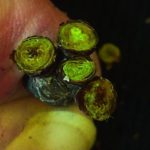
This winter was significantly colder than normal in the northern half of Indiana. Many areas north of “I-70” experienced temperatures between -15 and -20˚F in early January. That is cold enough to cause considerable cold injury to grapes, peaches, and blackberries. Ten below zero is a commonly accepted threshold for seeing damage to cold sensitive…Read more about Cold Injury to Fruit Crops[Read More]
One way insects communicate with individuals of the same species is with pheromones. Pheromones are volatile chemicals released by an insect that usually can be detected only by individuals of the same species. There are a number of different types of pheromones, but the most common type is the sex pheromone. Usually the females will…Read more about Pheromones and Pheromone Traps[Read More]
The Midwest Fruit Pest Management Guide is updated each year by the Midwest Fruit Workers group to provide the most complete information and recommendations for controlling weeds, diseases and insect pests of all major fruit crops grown in the Midwest. For the past three years, the guide has combined information on tree fruit, small fruit…Read more about Midwest Fruit Pest Management Guide (ID-465) available[Read More]

Check list: ~Indiana Disease management program for apples for 2018 is available at: https://www.extension.purdue.edu/extmedia/BP/BP-201-W.pdf This information is identical to the Midwest fruit pest management guide, but provided in a table format and includes Fungicide Resistance Action Committee (FRAC) Codes, REI, PHI and efficacy information for each product (Fig. 1). ~Reducing overwintering inoculum for apple scab:…Read more about Forewarned is Forearmed[Read More]
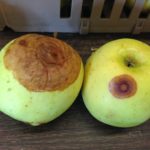
Summer rots continue to rear their ugly heads (Fig. 1). This year, we are even seeing them on late season apples like Evercrisp (Fig 2) and GoldRush. On the plus side, we are seeing some level of control with all fungicides in our trials (data will be presented at the Indiana Hort Congress); unfortunately,…Read more about Rot Redux[Read More]