Preharvest drop refers to the process where fruit fall from the tree prior to harvest. Not all apple varieties are affected, but with some, such as McIntosh and Pristine, pre-harvest drop can be extreme. Several growth regulator materials are available to growers to help reduce pre-harvest drop. These materials are often referred to as “stop-drop”…Read more about Control Of Preharvest Drop with NAA[Read More]
Crop Management
Making the decision on when to harvest can be a very tricky and complicated issue. The longer you intend to store the fruit, the more precise your timing needs to be. For summer apples, most growers only intend to store fruit until their better quality fall apples come on stream, so storage times beyond a…Read more about Determining apple maturity[Read More]
Apples and peaches are developing well and crops are looking good, although a little too heavy in places. Strawberry harvest is underway.
We’ve all heard of apple June drop, but what is it, what are the causes and why should we care? June drop is more correctly called physiological fruit drop and is caused by a shortfall of carbohydrates in the tree. This shortfall is because the trees have limited leaf area for photosynthesis (supply of carbohydrates)…Read more about Apple June drop[Read More]
Finally we have some warm, sunny weather, and that means fruit are growing quickly. Generally, fruit are 10–20 mm depending on where in the state you’re located. Many of our common post bloom thinners such as NAA, Sevin and Maxcell work very well when fruit are around 12mm and temperatures are in the 70s. Once…Read more about Apple Chemical thinning[Read More]
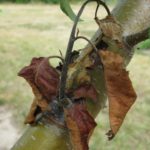
Fire blight seems to have established itself in many orchards throughout the state, meaning it can still be a huge threat in the event of trauma, like hail, due to secondary spread. Secondary spread develops when stormy weather, especially hailstorms, occurs after the primary (blossom) infections. The amount of fire blight that develops after severe…Read more about Fire Blight[Read More]
I received one of the most unusual samples to identify last week that I’ve seen during my time at Purdue. The sample contained almond nuts that were severely damaged by plum curculio. First, I didn’t know we could grow almonds in Indiana and, second, I didn’t know that plum curculio was a pest of almonds….Read more about Plum Curculio in Almonds[Read More]
As reported in the last edition of Facts for Fancy Fruit, we achieved biofix in Lafayette on May 9. With a lot of cool weather since then, we have only achieved 170.5 degree days as of May 24. This is a year when monitoring degree days has the potential to greatly improve your levels of…Read more about Codling Moth[Read More]

Immediate post-bloom through about 3 weeks post bloom is the most effective time for leaf removal on tight clustered varieties such as Vignoles, Seyval, and Pinot gris. That time will be coming up soon in southern Indiana. Removal of 3 to 5 leaves in the cluster zone can greatly reduce risk of Botrytis bunch rot….Read more about Leaf removal in grapes[Read More]