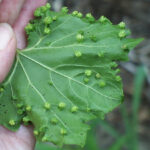
Phylloxera is an aphid-like insect that is native to the Eastern US. It has two distinct life forms: the root form, which feeds on the roots, can stunt growth and eventually lead to vine death. The foliar form of the insect causes galls on vine leaves (Figure 1) and is overall less concerning. The root…Read more about Managing Grapevine Phylloxera[Read More]
Disease Management
The most important time of the year for fruit disease control in grapes is from pre-bloom to 4-5 weeks past fruit set. The potential for fruit infection drops significantly 4-5 weeks post-bloom. Important diseases to control during this time include black rot, downy mildew and powdery mildew. Fruit of the most commonly planted varieties is…Read more about Critical Period for Disease Management in Grapes[Read More]
Leaving behind the fourth or fifth wettest April, rains continue in May. Many growers are confronted with serious issues with respect to scab management. Depending where you are in the state, development is at anywhere from petal fall to 2nd cover (kings at 10-11mm) or even further along. Against some pretty grim probabilities, most of…Read more about Scab management[Read More]
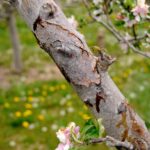
Fire blight, caused by the bacterium Erwinia amylovora, is a devastating disease of apples and pears. Epidemics of the disease develop quickly, particularly in a climate of warm, wet weather, with hail events. The type of management program developed by each orchard will vary considerably based upon a variety of orchard factors, including apple variety,…Read more about Fire Blight[Read More]
In addition to frost protection, disease management is pivotal during the blooming stage, particularly concerning gray mold (caused by Botrytis spp.) and Anthracnose. To protect the fruit, fungicide application should commence at or even before blooming. The pressure of both diseases is heavily influenced by weather conditions, with Botrytis favoring wet and cool climates and…Read more about Strawberry Disease Management Considerations at Blooming and Fruiting[Read More]
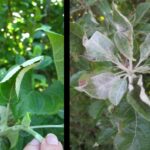
All that new, succulent growth needs to be protected to prevent primary (and even secondary!) scab (Fig. 1). We’re past the point where copper can be safely used, so protectant fungicides for scab control at this stage include mancozeb, ziram and captan. As an added bonus, all of these protect against the summer rots, and…Read more about Apple Disease Management Notes for April[Read More]
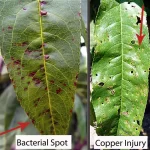
As of right now, we simply do not know if we will have crops from our woody fruit producing plants, from apples to grapes to peaches. Remember: The ability to produce fruit is determined in the spring with flower development. Any factor, whether abiotic, insect or pathogen, that interferes with flower development will impact fruit…Read more about Early season disease management[Read More]
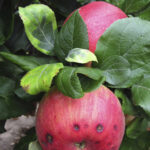
In Indiana, our ‘normal’ or average weather is one of extremes, punctuated with an occasional glorious summer day of sun and 76 degrees F. This year has been one of flooding and droughts, freezes and scorching heat. Again. With these weather extremes come physiological disorders and summer fruit rots, for those lucky enough to even…Read more about Pits, Spots and Rots[Read More]
Control Of Preharvest Drop with NAA: Preharvest drop refers to the process where fruit fall from the tree prior to harvest. Not all apple varieties are affected, but with some, such as McIntosh and Pristine, pre-harvest drop can be extreme. Several growth regulator materials are available to growers to help reduce pre-harvest drop. These materials…Read more about Control Of Preharvest Drop with NAA[Read More]
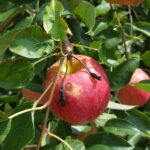
With increasing rains and extremely hot weather, this is a reminder that bitter rot weather is in full swing (along with black rot, white rot, sooty blotch and flyspeck!). Caused by fungi in the genus Colletotrichum, bitter rot thrives during warm, wet conditions, especially weather events that maintain fruit wetness for 8-12 hours, due to…Read more about Bitter Rot[Read More]