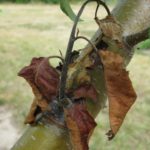
Fire blight seems to have established itself in many orchards throughout the state, meaning it can still be a huge threat in the event of trauma, like hail, due to secondary spread. Secondary spread develops when stormy weather, especially hailstorms, occurs after the primary (blossom) infections. The amount of fire blight that develops after severe…Read more about Fire Blight[Read More]
Disease Management

Immediate post-bloom through about 3 weeks post bloom is the most effective time for leaf removal on tight clustered varieties such as Vignoles, Seyval, and Pinot gris. That time will be coming up soon in southern Indiana. Removal of 3 to 5 leaves in the cluster zone can greatly reduce risk of Botrytis bunch rot….Read more about Leaf removal in grapes[Read More]
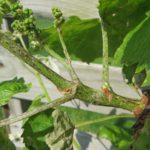
The weather this spring has been ideal for development of Phomopsis cane and leaf spot. The past few weeks have been cool with frequent showers, and shoot growth has been slow. These conditions favor sporulation and infection by Phomopsis. This pathogen is one of the major causes of fruit rot in the Midwest. Early season…Read more about Phomopsis cane and leaf spot in grapes[Read More]

Although the season for primary scab infection is winding down, this cool, wet weather is making for an excellent infection period for juniper rusts (Gymnosporangium spp). John Obermeyer and I created this time-lapse video to help explain the complicated lifecycle of this fascinating pathogen: http://tinyurl.com/j3s3t92 The juniper rusts standout due to the conspicuous nature of…Read more about Juniper Rusts[Read More]

Grapes in the southern half of the state will soon be reaching the critical pre-bloom stage, which is a key time to control important diseases such as black rot, downy mildew, and powdery mildew. The next three or four sprays will be critical in controlling fruit infections. Growers should pay extra attention to getting thorough…Read more about Important Pre-bloom Sprays for Grape Disease Management[Read More]

Fire blight, caused by the bacterium Erwinia amylovora, is a devastating disease of apples and pears. Epidemics of the disease develop quickly, particularly in a climate of warm, wet weather, with hail events—like last night’s 0.75” to 1.5” hail! The type of management program developed by each orchard will vary considerably based upon a variety…Read more about Fire Blight[Read More]
We’re getting close to the time when growers need to make chemical thinning decisions – for many the most perplexing and risky decision they will make all year. This is usually a tricky call to make, even more so when we have had spring frosts. Luckily in most places the spring frosts have not been…Read more about Chemical Thinning[Read More]

Grape growth is a bit ahead of normal this year. Grapes are at the critical 1 to 3 inch shoot length when Phomopsis cane and leaf spot infections occur. This is a critical time to take control measures for this disease. If left unchecked, the early shoot infections will spread to cluster stems and developing…Read more about Important Sprays for Grape Disease Management[Read More]

Weather for 2016 continues to be unpredictable. And although bad weather can damage crops, it does little to stop the pathogens that plague pome fruit. The past few weeks of cool weather has slowed things down, but not scab—at least, not completely. All plants, insects, and pathogens develop in response to temperature–The warmer the weather,…Read more about Unpredictable Weather[Read More]
The 2016 Midwest Fruit Pest Management Guide (ID-465) is available for purchase from the Purdue Education Store. This publication replaces two previous annual publications: The Midwest Tree Fruit Spray Guide (ID-168) and The Midwest Small Fruit and Grape Spray Guide (ID-169). This guide provides pest management recommendations for commercial tree fruit, small fruit, and grape…Read more about New Fruit Pest Management Guide Available[Read More]