
It will soon be time to put your spotted wing drosophila traps in place. Recent research has shown that the commercially available SWD traps are as good as or better than the homemade traps that we have been recommending. Most significantly, we don’t have to mess with the sugar/yeast mixture anymore. We have had good…Read more about Spotted Wing Drosophila[Read More]
Insect Management
I received one of the most unusual samples to identify last week that I’ve seen during my time at Purdue. The sample contained almond nuts that were severely damaged by plum curculio. First, I didn’t know we could grow almonds in Indiana and, second, I didn’t know that plum curculio was a pest of almonds….Read more about Plum Curculio in Almonds[Read More]
As reported in the last edition of Facts for Fancy Fruit, we achieved biofix in Lafayette on May 9. With a lot of cool weather since then, we have only achieved 170.5 degree days as of May 24. This is a year when monitoring degree days has the potential to greatly improve your levels of…Read more about Codling Moth[Read More]
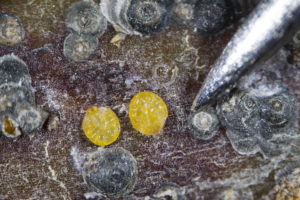
I have seen some pretty impressive infestations of overwintering San Jose scale this spring. These infestations re-emphasize the importance of putting on a dormant oil spray each spring, as scales are one of the pests controlled by that application. SJS overwinters as an immature and is now at the point of maturing. Shortly after, they…Read more about San Jose Scale[Read More]
I achieved biofix today (May 9) in our orchard at the Meigs Farm near Lafayette. I have also talked to other growers who had also caught 3-5 moths or more in their pheromone traps. For me, I had caught one moth last week and caught three more over the weekend. This constitutes a sustained flight and…Read more about Codling Moth[Read More]
Everyone knows that pollinators, including but not limited to honey bees, are important for the production of fruit crops. A big topic in recent years has been the stresses that reduce honey bee populations. Although not most important, pesticides are one factor that can reduce the populations of pollinators. Here are some things fruit growers…Read more about Pollinator Protection[Read More]
Apple growers should have their codling moth pheromone traps in place now. See the April 12 edition of Facts for Fancy Fruit for details of where traps and pheromone lures can be purchased. Traps should be checked for moths several times per week, if not daily. Pheromone lures should be replace about every 3 weeks….Read more about Codling Moth Pheromone Traps[Read More]
A number of growers have experienced increasing problems with woolly apple aphids over the last several seasons. Part of the reason for the increased populations may be related to the changing spectrum of insecticides you are using to control other pests. Our experience has been that many of the aphicides that are available that provide…Read more about Woolly Apple Aphid[Read More]
Management of European red mites is a continual process. Decisions made throughout the growing season will affect your mite populations. Outlined here are steps that can help with mite management. For a more complete explanation, please see the following publication: https://extension.entm.purdue.edu/publications/E-258.pdf. Put on a timely Superior oil spray. See the article above. Conserver predator…Read more about Mite Management in Apples[Read More]
One of the first and most important parts of a good insect and mite management program is the application of an early season oil spray to control European red mites, San Jose scale, and several species of aphids. Scales overwinter on the tree as nymphs and European red mites and aphids overwinter as eggs. Because…Read more about Oil Sprays[Read More]