Across the state of Indiana and the country the first pumpkin and winter squash plants of the season are popping up out of the ground. It is a time of great anticipation and usually triggers a series of phone call and emails to my inbox. Below, I address some of the frequently asked questions about…Read more about Pumpkin Weed Management FAQs[Read More]
Weed management
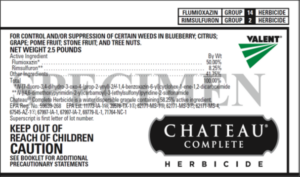
A colleague recently emailed me a label for a new herbicide, Chateau® Complete (Figure 1). I first applied Chateau® 18 years ago, and the label that landed in my inbox looked very familiar. It took me a minute to figure out how this was different from previous formulations (Figure 2). “Chateau® Complete” is actually a…Read more about What’s in a (Herbicide) Name?[Read More]
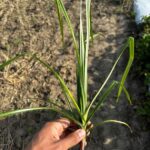
Common names: Yellow nutsedge, yellow nutgrass, nut sedge, chufa, earth almond, northern nutgrass Latin names: Cyperus esculentus L. Family: Cyperaceae (Sedge family) General Description Perennial sedges are among the most troublesome weed species globally. Because nutsedges look like grasses (Figure 1), they are often referred to as “nutgrasses”. They can be differentiated from grasses by…Read more about Weed Spotlight: Yellow Nutsedge[Read More]

REGISTRATION NOW OPEN! We are happy to announce that Purdue Extension is presenting its annual Fruit and Vegetable Field Day on July 18, 2024, at the Throckmorton/Meigs Horticulture Farm, Lafayette, IN. Register here: Purdue Fruit and Vegetable Field Day Contact Lori Jolly-Brown or Petrus Langenhoven if you have any questions. Presentations: Julia Wooby, Ian Kaplan, Laura Ingwell Trap Crop…Read more about Purdue Fruit and Vegetable Field Day[Read More]
Honeyvine Milkweed What is it? Honeyvine milkweed (Cynachum laeve) is a perennial, deciduous, vining member of the milkweed family, Asclepiadaceae. It is native to the United States and can serve as a host for monarch butterfly larvae. Honeyvine milkweed tends to be more problematic in production systems with reduced or no tillage, including perennial fruits….Read more about Honeyvine Milkweed[Read More]
What is Optogen®? The active ingredient in Optogen® (Figure 1) is bicyclopyrone. Corn growers may recognize bicyclopyrone as one of the four herbicide ingredients in Acuron® herbicide. Bicyclopyrone is a Group 27 herbicide with both pre-emergence and post-emergence activity on select weed species. Group 27 herbicides inhibit an enzyme known as “HPPD”, resulting in an…Read more about Optogen®- a new herbicide available in select vegetables and strawberry.[Read More]
Historically Stinger® herbicide application in Indiana strawberries was limited to post-harvest. A new 24(c) Special Local Needs Label now includes a spring application (Figure 1). Why does it matter? A spring application of Stinger® will help to manage certain difficult-to-control broadleaf weeds in the spring. This will reduce reliance on hand-weeding, reduce competition between…Read more about New 24(c) Special Local Need Label Allows for Spring Stinger® Herbicide Application in Strawberry[Read More]
Due to the COVID crisis, most Purdue Extension meetings will be held virtually. Most Purdue Extension staff are working from home and are available to answer your questions by email, phone or through social media. Our contact information is at the end of the newsletter. July 30, 2020 Small Farm Education Field Day and Webinar…Read more about Extension Events[Read More]
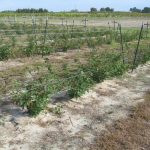
In perennial fruit crops, the orchard or vineyard floor is often divided into two distinct zones. Within the planted row portion of the field, weeds are managed- typically with herbicides. The between-row spaces or “row middles” consist of planted grass or native vegetation and facilitate the travel of equipment. Determining where the two zones meet…Read more about Considerations for Weed-Free Strip Width[Read More]
Due to the COVID crisis, all Purdue Extension meetings have been cancelled until further notice. Some may be offered by distance education, but no in-person meetings will be allowed. Most Purdue Extension staff are working from home. We are available to answer your questions by email, phone or through social media. Our contact information is…Read more about Extension Events[Read More]