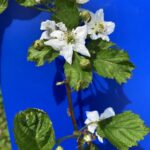
Hi! This week’s crop conditions are looking quite good despite not having any significant rain recently. Most crops have set fruit and are progressing well. The grapes received their second spray this season on the 9th. This is a busy time here at Meigs as we make raised beds for our vegetable crops and prepare…Read more about Crop conditions[Read More]
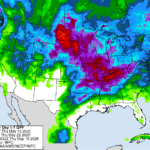
The last few weeks have been on the drier side, particularly for northwestern and west-central Indiana (Figure 1). While temperatures have been seasonal, they are still gradually increasing as we approach summer. Therefore, evapotranspiration rates are starting to increase. This has resulted in the U.S. Drought Monitor classifying much of northern Indiana as Abnormally Dry…Read more about A Bit of Rain Coming Our Way[Read More]
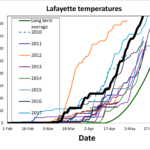
I’ve been plotting growing degree days for Lafayette for the last 15 years or so. This year we continue to track earlier than usual. This is a trend that seems to be continuing each year. See Figure 1. If you want to look at data more closely related to your location, the Indiana State Climate…Read more about Spring temperatures[Read More]
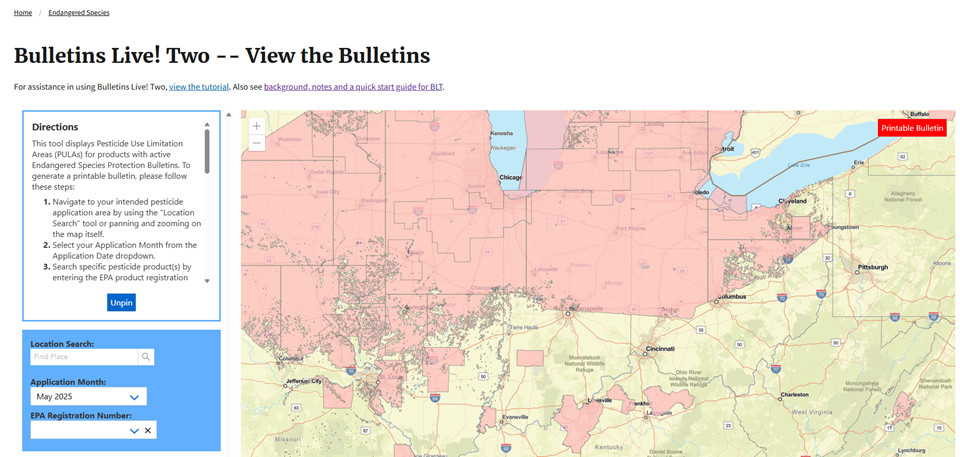
The EPA is enacting new requirements for agricultural pesticide applicators. An increasing number of pesticide labels require applicators to utilize an online system called Bulletins Live! Two to determine if additional pesticide use limitations are required to protect threatened or endangered species or habitat based on 1) application location 2) pesticide product and 3) application…Read more about New EPA Requirement for Pesticide Application[Read More]
The most important time of the year for fruit disease control in grapes is from pre-bloom to 4-5 weeks past fruit set. The potential for fruit infection drops significantly 4-5 weeks post-bloom. Important diseases to control during this time include black rot, downy mildew and powdery mildew. Fruit of the most commonly planted varieties is…Read more about Critical Period for Disease Management in Grapes[Read More]

New Sprayer Technologies & Best Practices: Vineyards & Orchards Tuesday, August 12th Quarry Hill Winery & Orchard Berlin Heights, OH GO.OSU.EDU/SPRAY2025 Indiana Horticulture Conference & Indiana Small Farms Conference March 3-5, 2026 Hendricks County Fairgrounds Danville, IN https://indianahortconference.org/ https://extension.purdue.edu/anr/_teams/dffs/small_farm_conference/index.html
Mancozeb can still be used in grapes during the 2025 growing season. However, the EPA has proposed to cancel the use of mancozeb in grapes in the future. The Federal Insecticide, Fungicide, and Rodenticide Act (FIFRA) is conducting a re-registration review of many multi-site fungicides, including ziram, thiram, captan and now mancozeb. The proposed cancellation…Read more about Update on Mancozeb Use in Grapes[Read More]
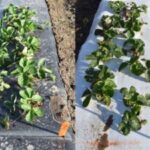
From 2022-2024, we evaluated the performance 15 strawberry cultivars grown in plasticulture system using black and white-on-black plastic mulches (Figure 1) at two locations: Southwest Purdue Agricultural Center in Vincennes, IN (USDA hardiness zone 6b), and Meigs Purdue Agricultural Center in Lafayette, IN (USDA hardiness zone 6a). Strawberries were harvested for two seasons. Plug plants…Read more about Performance of Strawberries on Black vs. White Plastic Mulches in Indiana[Read More]
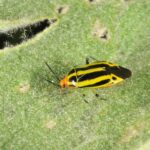
Last week I had the wonderful opportunity to visit a local grower who installed an insectary strip adjacent to their high tunnel last year. They will be hosting a field day in June, so I wanted to take a sneak peek and see how the plants (and insects) were doing. The plants are progressing well,…Read more about Introducing the Fourlined plant bug (Poecilocapus lineatus)[Read More]
The window for chemical thinning is rapidly closing in many parts of the state. Carbaryl can be effective up to 20 mm fruit diameter. After this stage, options become limited and we’re in a “rescue thinning” approach. Below is some information from Penn State University on rescue thinning options: Rescue Thinning Options – 20mm and…Read more about Chemical thinning[Read More]

Purdue University prohibits discrimination against any member of the University community on the basis of race, religion, color, sex, age, national origin or ancestry, genetic information, marital status, parental status, sexual orientation, gender identity and expression, disability, or status as a veteran. This material may be available in alternative formats. 1-888-EXT-INFO Disclaimer: Reference to products in this publication is not intended to be an endorsement to the exclusion of others which may have similar uses. Any person using products listed in this publication assumes full responsibility for their use in accordance with current directions of the manufacturer.