
“Spring” might be too strong a word to describe conditions this year. As we see from Figure 1, we’re now officially the latest spring so far this decade, and about the same as the long-term average. Having said that, a good part of our Growing Degree Day accumulation has come from one warm day on…Read more about Spring 2018[Read More]
Apples
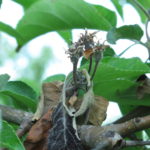
Maryblyt 7.1 is now available for download at http://grapepathology.org/maryblyt For new growers: Maryblyt is a fire blight prediction model. Fire blight is caused by the bacterium Erwinia amylovora. It is one of the most destructive diseases of apple, pear, and quince worldwide (Fig. 1). There are five distinct phases associated with fire blight, and include…Read more about Maryblyt[Read More]
The severe cold weather we experienced in early January had a dramatic effect on the number of surviving fruit buds on crops such as peaches. The impact was highly variable depending on a number of factors, primarily location within the state. If you have less than a full crop of any of your fruit crops,…Read more about Insect Management When You Have a Partial or No Crop[Read More]
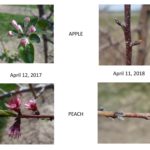
For organisms that don’t regulate their temperature (such as plants and insects), the rate of development is largely controlled by the temperature of their environment. As we know, fruit trees and vines need a certain amount of “winter chilling” that they use to measure when winter is over. After the chilling period, plant development depends…Read more about Plants and Temperature[Read More]
A new Monsanto-backed company is on the verge of producing the first fruit made with a blockbuster gene-editing tool that could revolutionize agriculture In a move aimed at securing its future, Monsanto has invested $125 million in a gene-editing startup called Pairwise. The alliance could tee up Monsanto, long known for its controversial dealings with…Read more about The First Fruit Made with a Blockbuster Gene-editing Tool[Read More]
The New York Times reports China has proposed countermeasures to a proposed $60 billion in tariffs from the U.S. on Chinese-made products. The Chinese Ministry of Commerce issued the threat in an online statement. American goods including nuts, wine, and fresh fruit would be subject to 15% tariffs. The Times reports these proposed tariffs in…Read more about China Proposes 15% Tariff on Fresh Fruit, Wine[Read More]
Of course, we all hope for a late spring to help avoid the risk of damage from late spring frosts. But when the temperature warms up then turns cold again, it leaves us in a real bind. The warm temperatures push tree development, then we want the warmer conditions for good pollinating weather. When we…Read more about Increasing Apple Fruit Set in Cold Springs[Read More]

So far it has been a cool spring, that in the northern half of the state has helped hold back bud development. As we can see from Figure 1, in Lafayette we have only accumulated 25 growing Degree Days (GDD), and most of these were the result of two warm days (54 and 63 F)…Read more about Spring Temperatures[Read More]
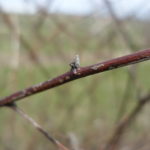
It has been a cool spring so far and most fruit crops are still relatively dormant in the Lafayette area. Early grapes are just at bud swell, red raspberries are also showing signs of growth, sweet cherry buds are swelling, and early apples are at silver tip. Fruit trees in Lafayette remain dormant, however are…Read more about Crop Conditions[Read More]