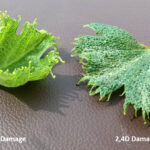
This is the time of year where we receive numerous reports of off-target herbicide exposure. Grapevines and fruit trees sensitive to growth regulator herbicides, including phenoxy, benzoic, and pyridine classes of compounds. 2,4-D and dicamba are the most common products, and they are used widely in corn and soybean production. Damage can range from minimal…Read more about Tips for Avoiding Herbicide Injury[Read More]
Found 836 Articles
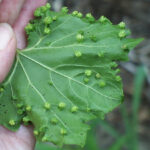
Phylloxera is an aphid-like insect that is native to the Eastern US. It has two distinct life forms: the root form, which feeds on the roots, can stunt growth and eventually lead to vine death. The foliar form of the insect causes galls on vine leaves (Figure 1) and is overall less concerning. The root…Read more about Managing Grapevine Phylloxera[Read More]
A new StrawberryChat podcast episode was posted: Farmer Interview with McNitt Growers: Neopestalotiopsis and Resistant Varieties | Episode 20, May 16, 2025 In this episode, we talk with Bill McNitt, owner of McNitt Growers—a nursery specializing in spring bedding plants and fall strawberry plug production. Bill shares his firsthand insights into how Neopestalotiopsis disease has…Read more about Strawberry Chat Podcast: Neopestalotiopsis and Resistant Strawberry Varieties[Read More]

Submit your content ideas for the 2026 Indiana Horticulture and Small Farm Conference. Do you want to hear from someone in particular or about a specific topic at this year’s newly combined conference? If so, please scan the QR code or follow the link below to submit your suggestions. The survey will be open until…Read more about We want your ideas! 2026 Indiana Horticulture and Small Farm Conference[Read More]
I want to remind everyone that the summer meeting will be held Wednesday July 9 at Chandler’s Orchard and Country Market: https://www.chandlersorchard.com The orchard and market are located in Fillmore, IN, just a little west of Indianapolis All are welcome to join us for an orchard tour and discussion of all things fruit, from growing…Read more about Indiana Hort. Society summer meeting[Read More]
The window for chemical thinning is rapidly closing in many parts of the state. Carbaryl can be effective up to 20 mm fruit diameter. After this stage, options become limited and we’re in a “rescue thinning” approach. Below is some information from Penn State University on rescue thinning options: Rescue Thinning Options – 20mm and…Read more about Chemical thinning[Read More]
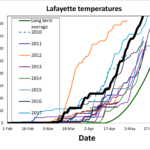
I’ve been plotting growing degree days for Lafayette for the last 15 years or so. This year we continue to track earlier than usual. This is a trend that seems to be continuing each year. See Figure 1. If you want to look at data more closely related to your location, the Indiana State Climate…Read more about Spring temperatures[Read More]
The most important time of the year for fruit disease control in grapes is from pre-bloom to 4-5 weeks past fruit set. The potential for fruit infection drops significantly 4-5 weeks post-bloom. Important diseases to control during this time include black rot, downy mildew and powdery mildew. Fruit of the most commonly planted varieties is…Read more about Critical Period for Disease Management in Grapes[Read More]
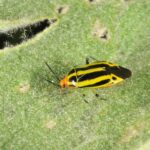
Last week I had the wonderful opportunity to visit a local grower who installed an insectary strip adjacent to their high tunnel last year. They will be hosting a field day in June, so I wanted to take a sneak peek and see how the plants (and insects) were doing. The plants are progressing well,…Read more about Introducing the Fourlined plant bug (Poecilocapus lineatus)[Read More]
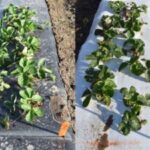
From 2022-2024, we evaluated the performance 15 strawberry cultivars grown in plasticulture system using black and white-on-black plastic mulches (Figure 1) at two locations: Southwest Purdue Agricultural Center in Vincennes, IN (USDA hardiness zone 6b), and Meigs Purdue Agricultural Center in Lafayette, IN (USDA hardiness zone 6a). Strawberries were harvested for two seasons. Plug plants…Read more about Performance of Strawberries on Black vs. White Plastic Mulches in Indiana[Read More]
Purdue University prohibits discrimination against any member of the University community on the basis of race, religion, color, sex, age, national origin or ancestry, genetic information, marital status, parental status, sexual orientation, gender identity and expression, disability, or status as a veteran. This material may be available in alternative formats. 1-888-EXT-INFO Disclaimer: Reference to products in this publication is not intended to be an endorsement to the exclusion of others which may have similar uses. Any person using products listed in this publication assumes full responsibility for their use in accordance with current directions of the manufacturer.