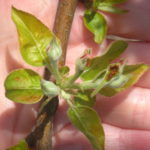
In the Midwest, extreme weather events are, unfortunately, regular occurrences, even in extremely unusual times. At this point, though, it just feels like a pile-on. Most fruit crops planted in Indiana are tolerant of the cold when they are fully dormant. In the spring, as trees break bud and begin to flower, they lose cold…Read more about After the Freeze 2020[Read More]
Found 92 Articles
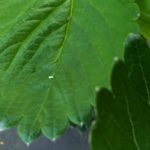
This winter-spring has been my first excursion into growing strawberries in a high tunnel. It didn’t take much for our own Wenjing Guan to convince me to plant some; who doesn’t love to eat fresh strawberries? We planted them back in October and I just peeked at them every couple of weeks throughout the winter,…Read more about Strawberry Observations from an Entomologist[Read More]
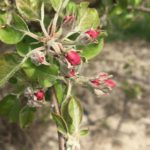
Apples in Lafayette are approaching pink. IN more southern areas of the state apples are past full bloom and into petal fall. Frost damage to crops has been widespread in southern areas of the state. Fruit crops are in early stages of growth across the state. In southern areas peaches and apples are in bloom…Read more about Crop Conditions[Read More]
Grapes are in the early stages of growth across the state, from bud break to 4 to 6 inch shoots. Significant frost and freeze damage occurred in central and southern areas so that will set growth back a couple of weeks as the secondary buds break. With a reduced number of primary shoots, protection of…Read more about Early season management of grape diseases and insect pests[Read More]
Due to the COVID crisis, all Purdue Extension meetings have been cancelled until further notice. Some may be offered by distance education, but no in-person meetings will be allowed. Most Purdue Extension staff are working from home. We are available to answer your questions by email, phone or through social media. Our contact information is…Read more about Extension Events[Read More]

Early spring is a good time to make the first herbicide application of the year in fruit plantings where a weed-free strip is maintained in the row (Figure 1). There are several options for fruit crops including both pre- and post-emergence herbicides. See the weed control chapter in the 2019-2020 Midwest Fruit Pest Management Guide…Read more about Spring Weed Management[Read More]
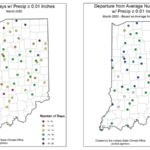
Staying true to global climate trends these days, March 2020 finished warmer and wetter than the 1981-2010 climate normal period. Snowfall across the state was below normal and localized flooding was a common feature. There were 3-to-5 more days than average in March where rainfall was observed (Figure 1). This has led to saturated soils…Read more about Was March any indicator of the next few months?[Read More]
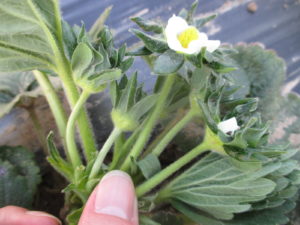
Warm temperatures this week greatly encouraged strawberry growth and development. Some of the early cultivars may have entered the open blossom stage especially if they are grown with the annual plasticulture system in southern Indiana. Open flowers cannot tolerate temperatures lower than 30°F, while popcorn stage flowers (Figure 1) and tight buds may tolerant temperatures…Read more about Strawberry Growers Should be Prepared for Cold Protection[Read More]
A new study from Cornell University has found that it takes as few as 10 minutes in a natural setting for college students to feel happier and lessen the effects of stress both physically and mentally. Just think what a visit to a farm market or an afternoon U-picking with the family could do. More…Read more about Spending time in nature reduces stress and anxiety[Read More]
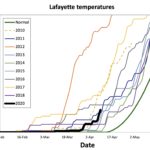
It can be useful to compare this growing with previous years. The typical way we calculate growing conditions is by calculating Growing Degree Days (GDD). This is somewhat similar to the method many are familiar with for calculating codling moth emergence. In Figure 1, we see the accumulation of GDD over the last 10 years….Read more about Growing season[Read More]
Purdue University prohibits discrimination against any member of the University community on the basis of race, religion, color, sex, age, national origin or ancestry, genetic information, marital status, parental status, sexual orientation, gender identity and expression, disability, or status as a veteran. This material may be available in alternative formats. 1-888-EXT-INFO Disclaimer: Reference to products in this publication is not intended to be an endorsement to the exclusion of others which may have similar uses. Any person using products listed in this publication assumes full responsibility for their use in accordance with current directions of the manufacturer.