We received a freeze warning in Vincennes last Sunday with a predicted low temperature of 33 °F. Growers in southern Indiana reported minimal damage on plants covered with floating row covers. But significant damage was observed in fields that were not protected or covered with a thin layer of floating row cover. At Southwest Purdue…Read more about Without Protection, Freezing Temperatures Monday Morning Caused Damage on Plasticulture Strawberries in Southern Indiana[Read More]
Strawberry
What is Optogen®? The active ingredient in Optogen® (Figure 1) is bicyclopyrone. Corn growers may recognize bicyclopyrone as one of the four herbicide ingredients in Acuron® herbicide. Bicyclopyrone is a Group 27 herbicide with both pre-emergence and post-emergence activity on select weed species. Group 27 herbicides inhibit an enzyme known as “HPPD”, resulting in an…Read more about Optogen®- a new herbicide available in select vegetables and strawberry.[Read More]
As we continue to walk on really expensive eggshells in 2023, it’s important to recognize that fungicide availability along with the effectiveness of available fungicides (and their price) will impact orchard, vineyard and berry patch management 2023. For all growers, the number 1 problem continues to be fungicide resistance in a diversity of fruit crops….Read more about Fungicide resistance in a diversity of fruit crops[Read More]
Using straws is the standard practice for winter protection in matted-row strawberry production. In contrast, plasticulture strawberries commonly use floating rows for winter and spring frost protection. This article will discuss the differences between managing floating row covers vs. straws in the spring. When straw is used, it blocks the light. There is hardly any…Read more about Spring Considerations on Using Floating Row Covers in Plasticulture Strawberry[Read More]
Purdue Extension presented its first Fruit, Vegetable and Hemp Field Day post-pandemic at the Meigs Ag Center in July 2022. Extension Specialists and Graduate Students presented specialty crop research to 45 attendees. Attendees had only good things to say about the event. ” Great information and research.” “Great variety of experiences and knowledge.” “I felt…Read more about Purdue Fruit and Vegetable Field Day – July 20, 2023[Read More]
The Tools: Hand lens-10x or 15x -To correctly use a hand lens, place the lens directly in front of your eye and bring the sample you are examining towards the lens until the object comes into focus. Knife – good for cutting into stems or root tissue. Pruning shears- for taking samples – disinfest blades…Read more about Scouting 101[Read More]
After a long cold winter under protection, nothing signals spring like the first blooms on strawberry. ‘Tis the season in our high tunnels and thus time to provide a few reminders/updates on how to protect the development of these early fruits from insect pests. The first thing you want to do is examine the health…Read more about Protecting Flowering Spring Strawberries from Insect Pests[Read More]
Dr. Janna Beckerman, Professor and Extension Plant Pathologist in the Dept. of Botany and Plant Pathology joined our discussion to talk about Spring Diseases and Management. Our discussion focused on Anthracnose fruit rot and Botrytis fruit rot. Janna described the biology of the pathogens and provided cultural and fungicide recommendations for managing these diseases. You…Read more about Strawberry Chat Podcast — Strawberry Spring Diseases and Management[Read More]
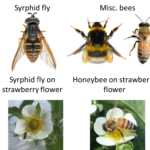
Insects provide an important pollination service in many crops including strawberry. Although strawberry flowers can self-pollinate without insects, it is well known that supplemental pollination by insects can result in better formed and larger fruit. Therefore, pollination services in strawberry affects both quantity (berry size) and quality (berry shape) of yield. By evaluating strawberry fruit…Read more about Fancy facts on strawberry pollination[Read More]