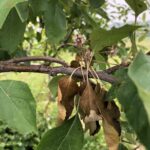
With last week’s thunderstorms and severe weather, fire blight continues to threaten crops: Hail can physically damage the tree and allow entry of the bacteria (Fig. 1) and secondary spread of the pathogen. Secondary spread of fire blight develops when stormy weather (especially hailstorms) occurs after the primary (blossom) infections. The amount of fire blight…Read more about Fire Blight[Read More]
Disease Management
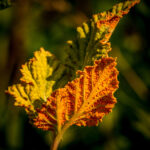
When Neil Young was singing about “Rust Never Sleeps,” I doubt he meant orange rust, caused by the fungus Gymnoconia nitens (formerly Arthuriomyces peckianus). But who knows? Maybe he did? And he’d be right: This rust is definitely not sleeping! Despite unusually dry conditions throughout much of the state, orange rust is still making its presence known…Read more about Orange Rust[Read More]
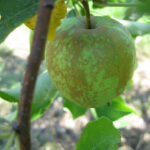
Currently, the US Drought Monitor (https://droughtmonitor.unl.edu/CurrentMap/StateDroughtMonitor.aspx?IN) places Indiana in the ‘abnormally dry’ category. With no rain in our 10 day forecast, I expect that to only get worse, and with it, powdery mildew on all fruit crops. Powdery mildew is identified by the white, powdery growth on leaves and shoots that consist of the fungal…Read more about Apple powdery mildew[Read More]
Shoots are at various stages of development across the state with some shoots at or near bloom. The most important time of the year for fruit disease control is from pre-bloom to 4-5 weeks past fruit set. The potential for fruit infection drops significantly 4-5 weeks post-bloom. Important diseases to control during this time include…Read more about Important bloom time grape sprays[Read More]
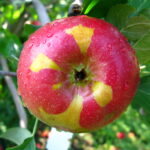
Tank mixtures (or tank-mixing) describes the process where multiple crop protection chemicals are combined in a single tank for simultaneous application. Tank-mixing pesticides allows the grower to make a single application but manage multiple pests AND pesticide resistance issues. All specialty crops, especially fruit crops, have more pests and pathogens than field crops, along with…Read more about Tank Mixes[Read More]
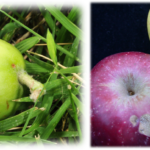
The plum curculio (Conotrachelus nenuphar) is a small “snout” beetle (also known as a weevil – one of my favorite beetle groups!) that will feed on apples, peaches, pears, plums, and cherries. Both adults and larvae have chewing mouthparts and can damage fruits; adults by feeding and laying eggs in newly set fruit and larvae…Read more about Tips for managing plum curculio in tree fruit[Read More]
As we continue to walk on really expensive eggshells in 2023, it’s important to recognize that fungicide availability along with the effectiveness of available fungicides (and their price) will impact orchard, vineyard and berry patch management 2023. For all growers, the number 1 problem continues to be fungicide resistance in a diversity of fruit crops….Read more about Fungicide resistance in a diversity of fruit crops[Read More]
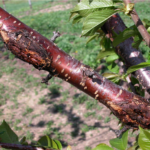
The Tools: Hand lens-10x or 15x -To correctly use a hand lens, place the lens directly in front of your eye and bring the sample you are examining towards the lens until the object comes into focus. Knife – good for cutting into stems or root tissue. Pruning shears- for taking samples – disinfest blades…Read more about Scouting 101[Read More]
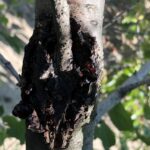
Another warning for severe brown rot of stone fruits (apricot, cherry, nectarine, peach, plum) (Fig. 1). Warm, wet, humid weather at harvest is particularly favorable for this fungal disease. Also, as fruit softens during the ripening process, it becomes much more susceptible to brown rot. Carefully picking and handling fruit to avoid injuries prevents infection…Read more about Brown Rot[Read More]
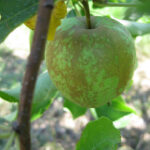
Crop loss in 2020 and 2021 led many growers to greatly reducing their fungicide applications, or use just captan or mancozeb, which, although effective against scab, are not effective against powdery mildew. Coupled with our unusually dry weather, this has led to a build-up of powdery mildew (PM) inoculum, and continued management issues surrounding this…Read more about Powdery Mildew[Read More]