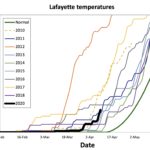
It can be useful to compare this growing with previous years. The typical way we calculate growing conditions is by calculating Growing Degree Days (GDD). This is somewhat similar to the method many are familiar with for calculating codling moth emergence. In Figure 1, we see the accumulation of GDD over the last 10 years….Read more about Growing season[Read More]
Crop Management
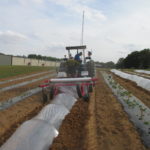
Strawberry production with the annual plasticulture system is successfully used in southern states. Plug plants are planted in fall and strawberries are harvested in spring the next year. The planting is usually not carried over to crop a second year. Compared with matted row system, annual plasticulture system has advantages such as easier weed and…Read more about Will Low Tunnels Make a Difference in Annual Plasticulture Strawberry Production?[Read More]

Grapes harvest has started in the Lafayette area. A bit of both powdery and downy mildew are present on leaves, but overall fruit quality looks great. Recent rains did not cause fruit cracking so fruit rots are minimal. Early apples are over and mid-season varieties are getting close. Fall bearing (primocane fruiting) red raspberries and…Read more about Crop Conditions[Read More]
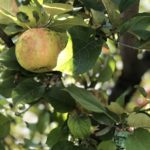
The symptoms of sooty blotch and flyspeck (SBFS) have begun to make their appearance. I know this because 1). I’m starting to see spots (Fig 1, 2 & 3). We have accumulated MORE THAN enough hours of post- petal fall leaf wetness needed for infection to occur, despite the sudden drought conditions. First, what is…Read more about Seeing Spots[Read More]
The grape harvest will get started in the southern part of the state in the next couple of weeks. Most varieties are slightly behind normal this year. In Lafayette, early varieties are at the start of veraison and should be ready to harvest in four to five weeks. We generally harvest early varieties such as…Read more about Grape Harvest Preparation[Read More]
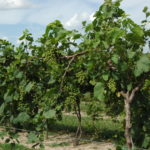
Apples look good and are sizing well. Brambles are not having a great year. Winter injury was severe and the wet spring has led to a significant amount of Raspberry (Septoria) leaf spot. Grapes are doing okay, despite significant winter injury. Appropriate pruning resulted in full crops of most varieties. Japanese beetles and 2,4-D damage…Read more about Crop Conditions[Read More]
On June 5, the Indiana State Department of Health (ISDH) mailed letters to produce growers having annual food sales over $500,000 informing them that inspections of produce farms would start in July. Due to their sales volume, these growers are expected to be in compliance with the Food Safety Modernization Act Produce Safety Rule (21CFR…Read more about ISDH- The Inspection Process Has Started![Read More]

At the Southwest Purdue Ag Center, we are studying annual strawberry production on plastic mulch. Our hope is to gather information for best production practices in our area. As we learn about insect and disease problems, we will pass this information on to producers. This article is about the insect pests we have observed in…Read more about Annual Strawberry Production[Read More]
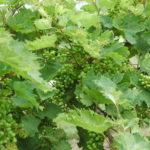
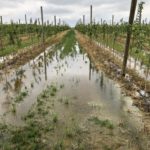
Current wet weather is increasing the risk of Phytophthora diseases in the orchard. Phytophthora is a major problem on apples and pear; stone fruit are also susceptible, with plums being the most resistant to this disease. In addition to excessive soil moisture and flooding, moderate temperatures, wounds (mechanical or through herbicide damage), and rootstock susceptibility…Read more about Phytophthora[Read More]